Saturday, January 31, 2009

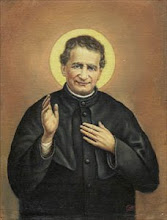
St. John Bosco A Labor of Love

Anyone who is familiar with St. John Bosco and his famous oratory for boys knew of his profound love for these children. His Preventive system of Reason, Religion and Kindness exhibited a formation of moral character that drew the most downtrodden young man in Turin to his doorsteps seeking the refuge of love. With this note I share the following letter written by St. John Bosco on his labor of love.

"First of all, if we wish to appear concerned about the true happiness of our foster children and if we would move them to fulfill their duties, you must never forget that you are taking the place of the parents of these beloved young people. I have always labored lovingly for them, and carried out my priestly duties with zeal. And the whole Salesian society has done this with me.

My sons, in my long experience very often I had to be convinced of great truth. It is easier to become angry than to restrain oneself, and to threaten a boy that to persuade him. Yes. indeed, it is more fitting to be persistent in punishing our own impatience and pride than to correct the boys. We must be firm but kind, and be patient with them.

I give you as a model the charity of Paul which he showed to this new converts. They often reduced him to tears and entreaties when he found them lacking docility and even opposing his loving efforts. . .

See that no one find you motivated by impetuosity or willfulness. . . Let us regard those boys over whom we have some authority as our own sons. Let us place ourselves in their service. Let us be ashamed to assume an attitude of superiority. Let us not rule over them except for the purpose of serving them better.

This was the method that Jesus used with the apostles. He put up with their ignorance and roughness and even their infidelity. He treated sinners with a kindness and affection that caused some to be shocked, others to be scandalized, and still others to hope for God's mercy. And so he bade us to be gentle and humble of heart. They are our sons, and so in correcting their mistakes we must lay aside all anger and restrain it so firmly that it is extinguished entirely. There must be no hostility in our minds, no contempt in our eyes, no insult on our lips. We must use mercy for the present and have hope for the future, as is fitting for true fathers who are eager for real correction and improvement.

Monday, January 19, 2009

Catholic Schools Week

THE AUTHENTIC LEADERSHIP OF A CATHOLIC SCHOOL EDUCATOR


The role of being a Catholic educational leader is very distinct as compared to a secular education leader. The reason being, the Catholic educational leader must direct his/her action toward Jesus Christ. Understanding this crucial point differentiates the position of both educational leaders.
In Catholic education as a whole there is a term used to describe the primary emphasis of instruction within a Catholic School environment as expressed in the General Directory for Catechesis. This term called (catechesis) means the authentic instruction of the faith centered on Jesus Christ. Jesus Christ is the Word that became flesh through the Divine Will of the Father.

The mission of catechesis has been practiced from the moment Christ was born. As part of the Church community the Catholic educational leader holds a responsibility not only to immerse him or herself in the Catholic faith, but teach it to all who will listen. The ministry of catechesis serves the Church in a decisive mission. This teaching first and foremost is passed on through the Apostles (the first trained Catholic Educators) and their successors, the Bishops of the Catholic Church. The moment of catechesis is that which corresponds to the period in which conversion to Jesus Christ is formalized, and provides a basis for first adhering to him. (GDC 63)

Quite early on, the name catechesis was given to the totality of the Church’s effort to make disciples, to help men believe that Jesus is the Son of God so that believing they might have life in His name, and to educate and instruct them in this life, building up the body of Christ. (CCC 4, Catechesis In Our Time 1;2)
It is in this totality that the Catholic Educational leader as stated in the General Directory for Catechesis and To Teach As Jesus Did must present a complete authentic instruction of the faith, faithful to the teachings of the Catholic Church so that the fruits of the Church may not go unnoticed or unpracticed. This task of catechesis, then, must be carried out under the guidance of the Church, whose duty it is to safeguard the truth of the divine message, and to watch that this ministry of the Word uses appropriate forms of speaking, while prudently considering the help which theological research and human science can give (General Catechetical Directory 38 and National Catechetical Directory 47). The Bishop holds the primary position of authority over programs of catechesis (Ibid 47).
The educational mission of the Church is an integrated ministry embracing three interlocking dimensions: the message revealed by God (didache) which the church proclaims; fellowship in the life of the Holy Spirit (koinonia), service to the Christian Community and to the entire human community (diakonia). While these three essential elements can be separated for the sake of analysis, they are joined in the one educational ministry (Teach As Jesus Did 14).

Catholic Educators are co-operators with Christ the Teacher. Their responsibility lies in creating a true Catholic environment for all children. This Catholic ethos rests on the use of Sacred Scripture and the Catechism of the Catholic Church. Both serve and establish a symphony of the faith rooted in the Blessed Trinity. The Trinity is central to all Christian understanding. It is the pillar of catechesis.

In conclusion a final point of emphasis for the Catholic Educational leader is expressed in the church document entitled The Religious Dimension of Education in a Catholic School where it in discusses the importance of climate; from the first moment that a student sets foot in a Catholic School, he or she ought to have the impression of entering a new environment, one illumined by the light of faith, and having its own unique characteristics. (25) The Catholic Educational Leader is called forth to exhibit a leadership that is distinctively Catholic in every fiber of a Catholic school.